
Guest post by Ben Heard
Around the world, credible objections to nuclear energy have progressively contracted to issues of time and cost to deliver. Even here, the data favours a large role for nuclear energy with other solutions. Yet the opponents are not all wrong either. Nuclear energy must improve its global profile in on-time and at-cost delivery, not to outpace renewables, but to displace more fossil fuels. For those primarily driven by effective action on climate change, that’s the difference between succeeding and failing. Observers will need to decide who they trust in this vital conversation.
Nuclear commentary in 2016 began with reinforcement of a transnational trend: credible objection to nuclear energy is increasingly confined to two issues: cost of the plants and time to deliver them.
This is welcome progress. It seems there has been too much discussion, transparent information and experience for the more traditional, fear-laden arguments to cut through the way they once did.
Friends of the Earth UK got this ball rolling back in 2013 when their commissioned independent review of nuclear energy left them with . Last year, The Australia Institute went to great lengths to present timeframes as a problem, butchering good process to get the desired result. Australian Senator Scott Ludlam could hardly find room for anything other than economics in his recent piece. Time and cost were the lead arguments in recent rebuttal at New Matilda and in a piece from Michael James to the Sydney Morning Herald.
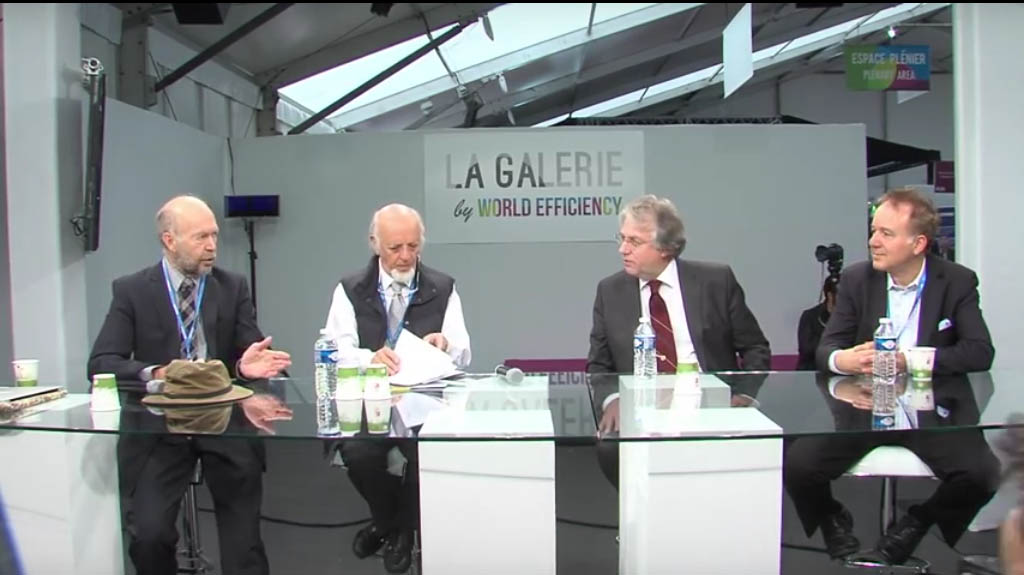
Recently, Joe Romm took up the topic[1] with a reflection on the work of James Hansen, Kerry Emanuel, Ken Caldeira and Tom Wigley (Hansen et al.) at the recent COP 21 meeting in Paris. What is complex about this piece is that much is basically factual and reasonable reflection of current findings for the nuclear industry. Sadly much is also highly selective, largely straw-man[2] argument. Romm ignores the core problem identified by Hansen et al: settling for energy pathways that are “reasonable” in today’s terms is a recipe for failure, so we must do more. This should be applauded and developed. Romm chose to belittle and undermine.
He observed, as many have before him, that new nuclear build is struggling to take off in liberalised energy markets. This perspective is one-eyed for two reasons. Firstly, by population these markets are the vast minority of the world. Most of the world’s people are not living in conditions so saturated in electrical generating capacity that planning has been handed over to market forces with short-term horizons. Consequently, most of the growth to come in energy demand will not be from liberalised markets but planned markets where the longer-term value presented by nuclear technology can carry more weight in decision-making. This is reflected in the recent request for procurement for 9,600 MW of nuclear power for South Africa [3]. This market opportunity must be fostered to tip energy investments in developing nations away from fossil fuels and toward nuclear. It is nuclear technology that presents a complete, fit-for-purpose technical substitute for coal.
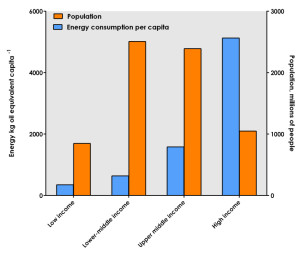
Figure 1 How most of the world lives- population and per capita energy consumption of different global income brackets. Data from United Nations Population Division; World Bank (World Development Indicators)
Secondly, this market situation also applies to more expensive renewables technologies with higher availability (such as solar thermal with storage). For hard evidence of the matter, Australia’s simplistically-conceived Renewable Energy Target is now 15 years old. In that time it has assisted to market not one solar thermal plant with energy storage. The price to meet the scheme has been mainly set by low-availability, lowest marginal cost on-shore wind[4]. Renewable advocates are swift to identify market failure and recommend either reform or different subsidies, rather than write-off the technology. What we need is both cheaper technology and affirmative policy that is technology neutral. That’s just what Hansen et al. are seeking.
Romm scoffed at Sweden as an example of rapid nuclear build because it relates to only 10 reactors. Yet normalised for population, nothing in history has been faster than nuclear for adding clean energy. Hansen et al. wisely call for reflection on that evidence. They spoke of a scenario of 115 reactor builds per year, something Romm described as “indefensibly absurd”.
Consider that there are currently 510 coal plants under construction globally and 1,874 in planning. Is that absurd? Horrific? Choose your adjective, however this is the scale of a world of 7-billion people and growing. Hansen et al. asked us to deploy that scaling effect to reliable clean energy. Labeling it “absurd” is simply part of the longitudinal effort toward self-reinforcing failure and inaction favoured by anti-nuclear commentators[5].
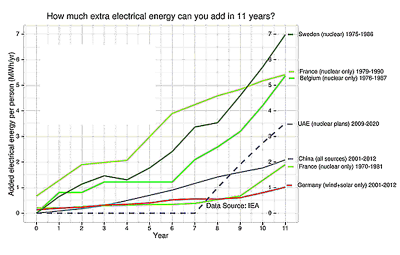
Romm described as “myth” the suggestion anti-nuclear activism holds back the expansion of nuclear power. This is flatly contradicted by Harvey Wassermann. He attributes the permanent premature closure of the Vermont Yankee nuclear station to “decades of hard grassroots campaigning” that “forced this reactor’s corporate owner to bring it down”. Australian activist Jim Green is unashamed in calling for mobilisation to prevent nuclear energy from having any access to the United Nation’s Green Climate Fund. He contends this could come at “the expense of renewables” and “we mustn’t let them get away with it!”. This raises technology tribalism to a new level of transparent grotesquery where the whims of western activists are prioritised over optimising mitigation outcomes in the developing world.
ENGOs direct resources toward activities that deliver results. Many maintain dedicated anti-nuclear campaigners and campaigns. This works toward prejudiced, technologically-tribal energy policies. Nuclear was excluded from while efficient coal plants were included. It was excluded from Australia’s technology-limited Renewable Energy Target that has, for nearly 15 years functioned as a slightly removed subsidy for wind and solar PV (and water heating). Nuclear has been disadvantaged by recent US policy that provides no recognition of extending the license of existing nuclear plants for carbon abatement. Romm’s assertion that the impact of activism is mythical is disingenuous.
So too is the pretence that it’s all the activist’s fault. There are real issues with time and cost for nuclear technology. I was quick to criticise the proposed cost of Hinkley Point C as too high. Others eventually withdraw support for that specific development claiming to be “pro-nuclear, but not at any price”. There is truth in Romm’s piece that currently nuclear just is not growing quickly enough, price is one driver of this and resolution of challenges is required to hit greater deployment. Hansen et al. known this: that’s their point. It is time for Romm and other climate hawks (to borrow his phrase) to get focused on solutions.
Instead Romm refers to the strong growth and falling prices in renewables to diminish this issue. This misses the point entirely. Take the most recent energy projections from BP to 2035. The projected growth in non-hydro renewables is an extraordinary 235 %, taking it to a larger share than nuclear energy in that time. Yet in absolute terms, the energy added is nearly the same as that added from a modest 20 % growth in coal alone. Meanwhile gas and liquid fuels (nearly all fossil) is projected to add 2.8 times more energy than the non-hydro renewables. So Romm is right: nuclear is growing too slowly. This is a problem that must be overcome. At this point, it behoves observers to ask who is interested in overcoming that problem, and who is interested in prolonging it.
Table 1 Projected energy growth across fuel groups in millions of tons of oil equivalent. Data from BP Energy Outlook 2015
| Annual consumption 2015 | Annual consumption 2035 | Growth 2015-2035 | |
| Liquids | 4,280 | 5,065 | 18% |
| Biofuels | 68 | 132 | 93% |
| Gas | 3,020 | 4,558 | 51% |
| Coal | 3,816 | 4,564 | 20% |
| Nuclear | 633 | 842 | 33% |
| Hydro | 898 | 1,249 | 39% |
| Wind/solar/other renewables | 347 | 1,177 | 240% |
It is clear that the nuclear sector must deliver more, beyond current expectations, if we are to decarbonise apace. It is wise, therefore, that as well as looking to (a) historic precedent to galvanise greater ambition and (b) affirmative market policy, Hansen et al rightly look also toward new generation reactors as one way to accelerate deployment. It is one reason I will direct efforts to the work of Terrestrial Energy as a member of their advisory board. This is not in place of my broader efforts in the clean energy discussion but in complement to them.
Whatever the eventual clean energy mix, the challenge is so great that the task will remain Herculean. We have to be prepared for that. But selective pieces such as Romm’s only serve to obfuscate the pathway to progress. This will render the task Sisyphean as the growth in energy demand overwhelms any gains we might make. Sober realism demands holistically looking at global energy requirements, historic technology deployment rates and advantages of various energy sources to forge optimised solutions for every part of the world and pressing to overcome barriers to that outcome. It is true that time is not our ally, so the sooner we move beyond simplistic, motivated argument, the better.
[1] I was at the press conference in Paris, as well as doing some work there of my own. The subsequent misrepresentation of Hansen et al. and other nuclear advocates has been positively willful. Fortunately the transcript is available here and a video of my panel is available here . Do not be misled by others regarding the message we brought and the motivations behind it.
[2] For another valuable reflection on the article from Romm, I refer readers to http://energyforhumanity.org/featured/nuclear-power-climate-activists-disagree/ by David Gattie
[3] Consider also the nuclear development programs of sun-drenched UAE and Saudi Arabia, the major programs of China and India as well as the preparations underway in nations like Kenya, Nigeria and Vietnam.
[4] There are a little over 500,000 certificates in the large-scale generation REC register attributed to solar and approximately 65.5 million certificates for wind. Currently, the two largest solar generating plants in Australia are PV with 155 MW capacity. Good solar resource is clearly not everything. REC Registry
[5] For more on the fallacies of the “time and cost” argument I recommend “Climate Gamble” by Partanen and Korhonen. There is no better assembly and consideration of these issues written for people with concern about climate change and clean energy