This is what the future is made of.
Guest post by David Gattie
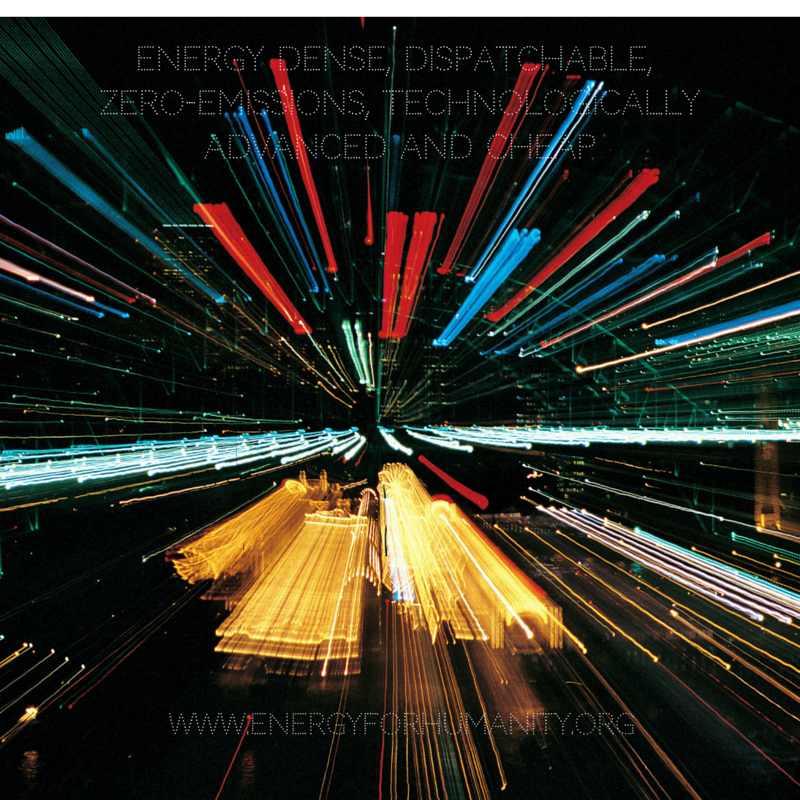
For my first post of the New Year I settled on nuclear as it’s the optimal resource for energy systems in society—energy dense, dispatchable, zero-emissions, and technologically advanced and the resource itself is cheap. It’s my sincere hope that the debate on the growth and development of nuclear power in the U.S. will be broached this year with rationale, logic, sobriety, and common sense given the challenges we’re facing. There is too much at stake and we have too many environmental constraints and economic goals in play to allow this resource to fade away or simply disappear from our industrial DNA while other countries throughout the world wisely invest in it and leverage its benefits in growing and developing their own economies.
DISCLOSURE:
1 I have substantial research activities in utility-scale solar PV;
2 I fully support nuclear power based on economic and environmental rationale.
CLIMATE EXPERTS WEIGH IN
In early December 2015 and in the middle of the Paris climate talks where 196 countries eventually came to a general agreement on reducing global carbon emissions, former NASA scientist and noted climate scientist/activist James Hansen, who is credited as being the father of climate change awareness, co-authored a brief op-ed promoting nuclear power as the single energy resource that “paves the only viable path forward on climate change…and…will make the difference between missing crucial climate targets or achieving them”. His co-authors are well-respected climate scientists Kerry Emanuel, Ken Caldeira, and Tom Wigley. Hansen, et al. make lucid and factual points and they acknowledge the critical role of renewables and the need to incorporate renewables into the world’s energy resource base. Moreover, they don’t promote nuclear as the exclusive answer to the world’s energy needs. Rather, they have a realistic grasp of the intermittency issues associated with renewables and, as such, they’re quite emphatic in their assertion that the combination of renewables and nuclear constitutes what they consider to be the optimal scenario for power generation in a growing and developing world.
It probably took all of a few minutes for the editorial by Hansen, et al. to reach the environmentalist community and raise the alarm for a response to be crafted and fired off around the world in order to quash the proposal by Hansen and colleagues. Sure enough, on January 7, 2026 Joe Romm published in ClimateProgress a rebuttal that summarily dismisses James Hansen as being “wrong about nuclear power”. In his article, the highly credentialed climate activist Romm, who is a former acting assistant secretary of energy for energy efficiency and renewable energy and holds a Ph.D. in Physics from MIT, bases his objection to nuclear on two core issues that he believes undermine nuclear as a legitimate option. From Romm’s article: “The nuclear power industry has essentially priced itself out of the market for new power plants because of its 1) negative learning curve and 2) inability to avoid massive delays and cost overruns in market economies. This is doubly problematic because the competition—renewable power, electricity storage, and energy efficiency—have seen steady, stunning price drops for a long time”. Romm continues with several references to support his position. One in particular is a major report by the Nuclear Energy Agency (NEA) and International Energy Agency (IEA). I’ve looked at this report and can’t determine the basis on which Romm can justify using it as a reference to support his outright rejection of nuclear power. The study points out the safety issues as well as the costs associated with nuclear, but, it states directly that the “medium to long term prospects for nuclear energy remain positive”. In addition, Romm points to the issues of nuclear safety and waste.
Romm’s rebuttal, one-sided as it is, does raise points that warrant discussion. Regarding the safety and waste issues in the nuclear cycle, these will always be paramount concerns in the nuclear industry and God help us if we ever take these lightly. However, the U.S. performance record in nuclear safety is exemplary and isolated examples from Chernobyl and Fukushima aren’t sufficient cause to stanch the industry as a whole. Regarding waste, it’s glaring that in his piece Romm selectively restricts his waste concerns to nuclear, but chooses to avoid pointing out that the renewable energy field is completely dependent on heavy metals and rare earth elements, which have serious environmental and human health concerns regarding toxicity associated with the mining and processing required to prepare them for deployment in technologies such as solar panels. Does that mean we should abandon solar PV because it doesn’t measure up to the zero-risk, zero-waste criteria that we hold forth for fossil fuels and nuclear? Of course, not. And in a fair, objective discourse on such a critical issue as energy in society, no reasonable person would propose such a thing. Romm, however, does not take such an objective approach in his selective identification of the waste issues with nuclear while choosing to not mention waste issues associated with solar PV.
With respect to the construction of new capacity, the nuclear power industry in the U.S. has been dormant since the 1970s due to public sentiment and costs at that time. Nonetheless, the U.S. currently is the world’s leading producer of nuclear power, accounting for about 30% of global generation, according to the World Nuclear Association, all the while maintaining a stellar safety record. As for costs, I share Romm’s concern regarding construction costs but do not accept his hypothesis that the nuclear industry is suffering from a negative learning curve—this simply hasn’t been proven and the World Nuclear Association even points out in their Economics of Nuclear Power that there is significant variation of capital costs by country and with few new orders, the data set for new build costs is lacking. As such, it’s disingenuous to disparage an industry, an industry that has been throttled for 40 years in the U.S. but growing in the rest of the world, simply because that industry didn’t come out of a politically-induced coma without a stumble, misstep or miscalculation. I’ll guess that Romm is thankful we didn’t take a similar approach to solar PV back in the 80s when costs were over $20/kW (in $2009), but, instead, allowed innovation to take its due course. Consequently, solar has made great progress, albeit with substantial government subsidies.
Romm does point out one thing with which I agree and have deep concerns. That being, nuclear will struggle to compete in merchant power markets where the prevailing objective is short-term electricity prices but no incentives or mechanisms in place for capitalizing the costs to meet long-term energy needs over the course of 40-50 years. I commented on this in a previous post of mine where I discussed the shutting down of 2,148 MW of nuclear capacity recently in merchant markets in the northeast U.S. While Romm contends that nuclear has priced itself out of power markets, I’ll contend that if we have a U.S. power market model that precludes a zero-carbon energy resource such as nuclear, then it represents a flaw in the merchant market model, particularly with respect to carbon constraints. It needs to be pointed out that renewable energy itself is currently a resource in the power generation sector, not because it is inherently inexpensive or easily managed by power producers, but because it has environmental value (i.e., zero emissions). If a power market model were structured such that it precluded solar or wind based predominantly on costs the outcry from environmentalists would be deafening and they would assert that the true value of solar is not comprehended in costs alone. There are, in fact, that incorporate what is referred to as “” where the value of solar is calculated based on parameters ranging from easily-determined energy and line losses to highly-subjective environmental benefits. As for giving nuclear the same benefit for its environmental value, not to mention its inherent dispatchability value, the silence from the same environmentalists is equally deafening. This isn’t a fair and objective manner for debating the critical issue of energy.
Romm also claims that the cost of nuclear is “doubly problematic because the competition—renewable power, electricity storage, and energy efficiency—have seen steady, stunning price drops for a long time”. This just isn’t the case. While the cost per kW for renewable energy technologies has certainly dropped significantly, renewable energy itself still cannot stand on its own two intermittent feet, but requires the backup of dispatchable fossils and nuclear—and these backup dependency costs are not reflected in the “stunning price drops” Romm mentions. Regarding electricity storage, which is certainly a critical future need in the energy industry, it isn’t economically feasible, yet. As for energy efficiency, while we should always encourage efficiency, we need to face the facts of reality on this one—energy efficiency has a floor and there is only so much energy that society can stop consuming.
My last point regarding the Hansen-Romm editorials. Hansen et al. are evenhanded in their assessment of nuclear and renewables; they don’t throw renewables under the bus, and they’re upfront about the safety and waste issues associated with the nuclear fuel cycle. However, they make the simple, realistic and obvious point that is understood by every single human being in the energy world, and that is that renewables have one fundamental flaw of nature that is problematic for energy systems in society: Renewables are intermittent. While Romm aggressively attacks nuclear, although he throws a bone to small modular reactors and he doesn’t propose shutting down all nuclear plants, he never one time addresses this fundamental flaw of renewable energy. Not one time. In fact, the word intermittency isn’t even in his article. Shame!
Actually, let me rephrase that—Typical!
CLOSING WORDS
In 2015 we witnessed landscape changes in the energy sector for the U.S. and the world. Among them were EPA’s unprecedented regulation of the U.S. power generation sector through the Clean Power Plan and a global agreement on carbon reduction at the Paris COP 21 climate talks. For environmentalists, this is like the dog finally catching the car it’s been chasing for years. The problem is it falls to industry to figure out what to do with it because environmentalists are experts at barking at cars but not operating or maintaining them.
Energy alone is a natural resource subject to the laws of physics, chemistry and biology, and every sovereign nation in the world occupies itself with increasing its capacity to acquire it and convert it into a form that can be used in providing its own society and economy with mobility, power and heat. And, of all the energy resources in the world, nuclear is the only high density, dispatchable, zero-emission energy resource that can meet the immediate and long-term dual objectives of economic growth and low carbon emissions, particularly with respect to countries that will develop their economies and improve their own prospects for wealth and prosperity, regardless of globally agreed upon carbon targets. Yes, energy alone is a natural resource; but energy in society is something altogether different. Energy in society is power, leverage, strength and authority, and energy decisions are based on economic needs, politics, aspirations and beliefs. The debate I have presented here is an example of climate change activists disagreeing on something that you might think would be logical and easily agreed upon. However, while one side is practical, rational and forthcoming in its argument, the other side is more selective in its argument against nuclear and seems to give precedence to personal preferences and uses selective arguments to support those preferences. We cannot afford to address economic growth and environmental issues with these sorts of arguments. The human and environmental welfare of a developing and growing global community deserves better than that.
So, here’s to 2016…and the hope for a rational, pragmatic, sober and common sense conversation that will advance nuclear power in the U.S. for the next 50 years.
Guest post by @DavidGattie