![If cafes talked about hygiene like nuclear plants... [DM 14.4.16]](/wp-content/uploads/2016/04/If-cafes-talked-about-hygiene-like-nuclear-plants...-DM-14.4.16-444x255.jpg)

“The other thing that needs to be said about all of this technology is that this is not a dream. This is not somebody’s calculations on a piece of paper. This is real. We know how to do these things.” ~ Dr Charles Till
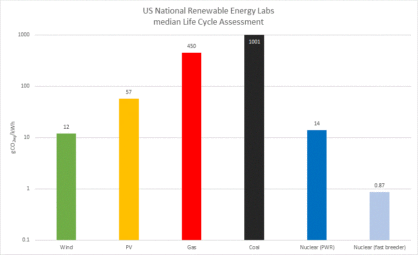
In 2012, the US National Renewable Energy Laboratory undertook a comprehensive review of the various life cycle assessments of every major energy source used by humans. These assessments attempt to establish how much greenhouse gas (generally denoted as CO2 equivalent) is released from “cradle to grave” when we get useful power from coal or gas plants, nuclear reactors and, yes, solar panels and windfarms.
Here is a comparison of the US NREL’s unharmonised median results for a relevant selection of technologies.
We’ve probably all played games like Sim City, right? We’re familiar with the disaster options which can make the game more challenging? If one of those options was “anthropogenic climate change” due to emissions from power plants, which technology would we save up our dollars to build?
Reality is more complex (and doesn’t have save files). For example, electrical energy production is a large source of emissions, but there are others like transport and agriculture. The challenge is also really huge, so while the regulations and effort involved in installing rooftop solar are relatively simple, the rate at which overall emissions are scaled back by it is, so far, limited.
If big emissions reductions are front and centre for us, the LCA for conventional nuclear already looks very attractive.
But for fast breeder reactors, at less than a single gram of greenhouse gas per kWh over their whole lifetime, shouldn’t everyone sit up and take note?
Many of these liquid metal-cooled, fast neutron spectrum reactors have been built, and numerous design and operational challenges have been faced. Improved models are slowly coming online in countries like China, Russia and India.
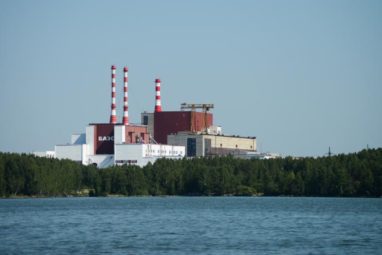
A real life working fast breeder reactor
At the same time, opposition to breeder reactors has developed into something of a modern mythology. Proliferation is the big bad, but apart from some old third-hand guesses about the plutonium from a French reactor (see page 91), there are no signs that anyone has ever gone to the extra trouble of making weapons material this way.
Coolants like liquid sodium certainly sound risky. Yet by containing the reaction in a pool-type vessel, there is no physical way for this molten metal to leak or come into contact with air or water. Sodium is also a standard coolant for solar thermal technology.
When it comes to demonstrating these features, one particular reactor stands out above them all: Argonne National Labs’ Experimental Breeder Reactor II. Throughout its 30 year operation it methodically addressed the issues plaguing other breeder technology, the true on-site recycling of fissionable fuel, the hazards of equipment failure, and the uniquely safe synergy of sodium coolant with alloy fuel.
Work was halted in the 1990s, mere years from completion, for political reasons. Some of the programme’s biggest critics are now strident climate campaigners.
Let’s see that chart again. No logarithmic scale this time.
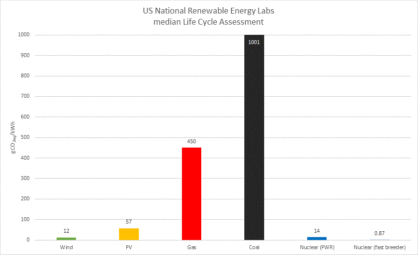
The EBR-II was the flight at Kitty Hawk for truly sustainable nuclear energy. Decades on, commercial demonstration of the technology is ready to proceed in the form of from General Electric Hitachi, and that diminutive 0.87 gCO2eq/kWh is needed more urgently than ever. With breeder reactors, the full service of fossil fuel combustion can be replaced entirely. With breeders, the world’s supply of uranium can be extended into the far future.
It won’t start out cheap. The most recent authoritative assessment puts the first twin unit 622 megawatt plant at $6 billion USD. But these reactors are intended for assembly line manufacture, maximising economies of production, and if we can manage that for gravity-defying machines which affordably carry millions of happy people through the air every day (above the heads of equally unconcerned folks), we can do it for new nuclear plants that operate at normal pressure and can’t melt down.
Perhaps the most bizarre objection to this technology is that it’s too efficient. Under a recent major proposal, South Australia would take custody of international used fuel for a handsome fee. Spending just a fraction of this on a single PRISM plant, powered for 60 years by 4,000 metric tonnes of recycled fuel, would leave 56,000 tonnes of the stored fuel unconsumed. Perhaps forgetting the urgency of switching to climate-friendly energy sources, some campaigners decry this as a shortcoming; in fact, expanding this capacity to a fleet of fast breeder reactors sufficient to fission every last tonne could meet a third of Australian electricity demand for the 21st century.
A third of Australian demand - currently dominated by coal - at less that 1 gCO2eq/kWh. A modern, efficient power plant that doesn’t emit any pollution. And objections that just all ring so hollow when we think about them.
What are we waiting for? Climate change?